What is LED? Features & Uses
An LED is a semiconductor diode that turns electricity directly into light - efficient, long-lived and easy to control. How to choose one: colour range 1800K-10000K/RGB, IP65/IP68, DMX512 control.
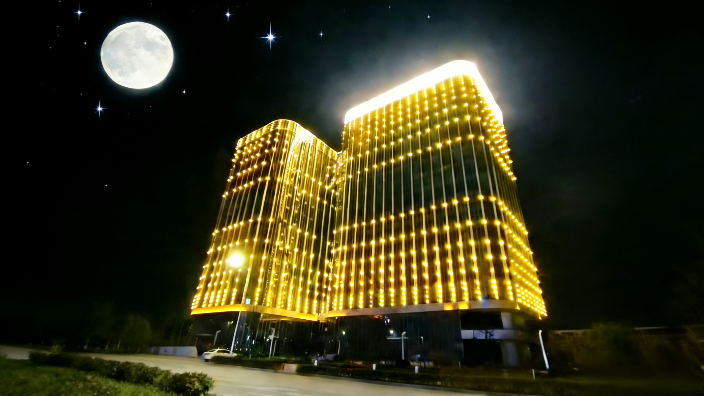
An LED is a semiconductor diode that emits light when current passes through it — efficient, long-lived and easy to control, which is why it took over architectural lighting.
Unlike an old lamp that makes light by heating a filament or exciting a gas, an LED turns electricity directly into light. Very little energy is wasted as heat, which is the reason LED lighting uses a fraction of the energy of the lighting it replaced — and the reason it has become the standard for building facades, landscape lighting and decorative lighting worldwide.
The features that matter
Energy efficiency. An LED fixture delivers the same light for far less power than the lamps it replaced. On a large facade that runs every night, the saving is substantial.
Long life. With no filament to burn out and no glass tube to break, an LED fixture keeps working for years. That matters on a facade, where replacing a failed fitting means scaffolding or a lift.
Easy control. An LED can be dimmed smoothly and, in RGB versions, set to any colour — and with DMX512 control, thousands of points can be programmed to run in sync. That control is what makes modern facade shows possible: gradients, chasing, radial effects and full media facades.
Compact and robust. LEDs are small and solid-state, so fixtures can be slim, linear or point-sized, and built to survive outdoors in aluminium housings with tempered glass covers.
Where LEDs are used in architectural lighting
- Facade lighting — wall washers and linear lights that wash whole buildings in even light.
- Pixel and point lights — individually controlled dots for outlines, media facades and landmarks.
- Landscape lighting — in-ground lights, tree lights and step lights for parks, streets and gardens.
- Water lighting — fountain and underwater lights for plazas, pools and water shows.
- String lights — curtains, nets, icicles and tree wraps for streets, hotels and festivals.
Choosing LED architectural lighting
Three things decide a good choice: colour temperature range (UTU's range covers 1800K–10000K plus RGB), weatherproofing (IP65 or IP68 for outdoor fixtures), and control (DMX512 for colour-changing and synchronised effects). A supplier that offers free lighting design with a realistic effect rendering, free DMX programming and free online technical support makes the choice easier — you see the finished night scene before anything is made.
Examples from the UTU range
- Wall washer — UT6001: 18W/24W/36W, DC24V/AC220V, 1800K–10000K/RGB, IP65/IP68, aluminium + tempered glass, 1000 mm.
- Linear light — UT6101: 12W/15W, DC24V, 1800K–10000K/RGB, IP65, W23×H26×L1000 mm, aluminium + tempered glass.
- Pixel point light — UT8801: 5–9W, DC24V/AC220V, 1800K–10000K/RGB, IP65, Ø118×67 mm, die-cast aluminium + tempered glass.
- In-ground light — UT8101: 1–3W, DC24V/AC220V, 1800K–10000K/RGB, IP65, Ø75×H100 mm, die-cast aluminium + tempered glass.
Frequently asked questions
What colour temperatures are available?
1800K–10000K plus RGB across the UTU range — from warm 1800K for hotels and hospitality to cool 10000K for commercial facades, with full RGB colour on top.
Do LED fixtures need a power supply or controller?
Low-voltage fixtures run on DC24V, and colour-changing fixtures need a DMX512 controller. UTU supplies matching controllers and power supplies, and provides free programming and online technical support for installation.
Are LEDs really cheaper to run?
Yes. An LED fixture uses a fraction of the energy of the lighting it replaced, and on a facade that runs every night the saving is substantial — while the light stays the same.
Which LED fixtures suit a facade?
It depends on the effect you want: wall washers such as the UT6001 for an even wash, linear lights such as the UT6101 for outlines, and pixel points such as the UT8801 for individually controlled dots and media effects.